.comment-link {margin-left:.6em;}

Emet m'Tsiyon

Wednesday, November 23, 2016

Colosseum Built with Money from Loot from Rome's Jewish War

See additional info at bottom of page

UNESCO disgraces its assigned mission to protect the world's cultural heritage and enhance it and defend it. It did so by adopting a resolution proposed by Arab states, working with the PLO/Palestinian Authority/, that denied the Jewish historical connection to the Temple Mount in Jerusalem and its sacredness in the Jewish religion.

However, Italian archeological authorities are more honest. They frankly state that the Colosseum in Rome was built with loot from the Jewish War finally concluded while the Colosseum was already under construction. This determination was made in the last 15 years on the grounds of the recent discovery, or shall we say reexamination of previously discovered monumental stones that had not yet been thoroughly and sufficiently examined in the past, a common problem in archeology. Furthermore, it is likely that much or most of the loot taken from Judea [IVDAEA CAPTA to the Roman Empire of the time] was taken from the very Jewish Temple on the Temple Mount. We say this since we know that monetary contributions to the Temple from Jews throughout the Diaspora for ritual purposes were stored in the Temple. Further, the Arch of Titus, only about 150 or 200 meters north or northwest of the Colosseum, shows loot from the Temple, such as the golden menorah, being carried in a Roman victory parade, a triumph, through the streets of ancient Rome.

A standing sign inside the Colosseum states in two languages, Italian and English:

the colosseum, history

In AD 72 the emperor Vespasian used the spoils of his Jewish campaign to build Rome's first permanent amphitheater to host hunting spectacles and gladiatorial combats . . . .

il Colosseo, la sua storia

Nel 72 d C,  l'imperatore Vespasiano intraprese con il bottino della guerra giudaica, la costruizione del primo amfiteatro stabile di Roma . . .

It is a shame that the honesty of the Italian archeological authorities and their promptness in bringing the newly discovered information to the public's knowledge was not matched at the UNESCO vote by the Italian foreign ministry, which abstained on a matter of well known historical fact. Prime Minister Matteo Renzi, to be sure, expressed his regret over the vote. Could someone please notify UNESCO, and its Arab members especially, about the extensive literature in ancient Latin, Greek, and Hebrew writings, as well as in other languages, about the Jewish War, not to mention the archeological discoveries, the continuously known Arch of Titus, the coins and other concrete reminders of that war and the battle against the Jews in Jerusalem?
- - - - - - - - - - - - - -
Other Related Info
The war, called by the Romans the Jewish War, started in 66 CE and ended in 73 CE (or in 74 CE, according to some scholars) with the fall of the fortress of Masada to Roman forces. Incidentally, Arab auxiliary troops fought for Rome in the war, including at Jerusalem. All considered, the bulk of the fighting was over in the summer of the year 70 CE when the Romans captured the Temple of Jerusalem and looted it, as said above. Thus they would have been able to start building the Colosseum before the actual end of the war.
--on the Menorah's importance for Jews here  and here.
--the Menorah goes from Jerusalem to the Roman "Peace" Temple   here.
-- better pix of the bas reliefs on the Arch of Titus plus inscriptions on it here. Click on the photos to enlarge.
-- Depiction of the Temple utensils in an ancient Jewish mosaic from the Byzantine period here. By the way, these photos of ancient Jewish mosaics are found in a book published by UNESCO. But that was long ago.
-- commentary on outrageous UNESCO vote here.
-- The Romans minted coins to commemorate their victory over the Jews with at least two types of insciptions on them. One was Judea Captured/Conquered [IVDAEA CAPTA]. Another was Judea Defeated [IVDAEA DEVICTA]. A third inscription used was Judea Recaptured [IVDAEA RECEPTA] on a gold coin (aureus). Few of these IVDAEA RECEPTA coins were minted although they may have been minted first. It seems that they were then replaced by IVDAEA CAPTA and others. I will report on the Judea Recaptured coin soon. One of this type is on display at the Israel Museum in Jerusalem.
See pix of Jewish coins of the Revolt as well as other ancient Jewish coins here.

ADDED 5 December 2016
The scholar who determined that loot from the Jewish war, especially from the Temple in Jerusalem, financed the building of the Colosseum in Rome was Professor Geza Alfoldy, a Hungarian. See links here & here.


Labels: , , , , , , , ,

Wednesday, January 18, 2012

Jewish Temple Menorah Found Illustrated on Ancient Bread Stamp

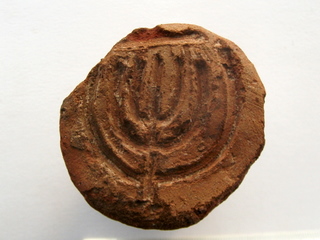
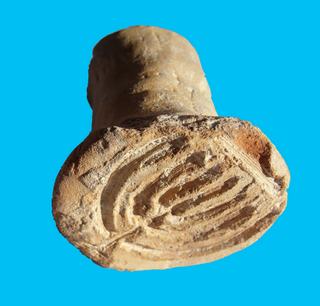
Another sensational archeological find!! The Israel Antiquities Authority announced the finding of a Byzantine era bread stamp showing the menorah [candelabrum] of the Jewish Temple in Jerusalem. The seven-branched menorah was a common Jewish symbol in the centuries after destruction of the Temple by Roman and auxiliary forces in 70 CE. A Greek-language inscription was found on the knob used to hold the stamp. This inscription seems to be the baker's name. He was advertising kosher quality of his product and his own bakery. See photos at bottom of this post.
What do the Arabs and their friends who lately and fashionably have been denying the Jewish history of the Land of Israel [as per PLO charter, Article 20; see at bottom] have to say about that?
- - - - - - - - - - - - - - - - - - - - - - - - - - - - - - - -


A Stamp with the Temple
Menorah was Uncovered in Excavations near Akko (January 2012)


The tiny stamp was used to identify baked products and it probably belonged to a bakery that supplied kosher bread to the Jews of Akko in the Byzantine period

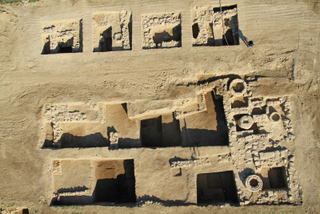
General view of the excavation
A 1,500 year old seal bearing an image of the seven-branched Temple Menorah was discovered near the city of Akko.
A ceramic stamp from the Byzantine period (6th century CE) was discovered in excavations the Israel Antiquities Authority is currently conducting at Horbat Uza east of Akko, prior to the construction of the Akko-Karmiel railroad track by the Israel National Roads Company. This find belongs to a group of stamps referred to as “bread stamps” because they were usually used to stamp baked goods.
According to Gilad Jaffe and Dr. Danny Syon, the directors of the excavation on behalf of the Israel Antiquities Authority, “A number of stamps bearing an image of a menorah are known from different collections. The Temple Menorah, being a Jewish symbol par excellence, indicates the stamps belonged to Jews, unlike Christian bread stamps with the cross pattern which were much more common in the Byzantine period”. According to Syon, “This is the first time such a stamp is discovered in a controlled archaeological excavation, thus making it possible to determine its provenance and date of manufacture. The stamp is important because it proves that a Jewish community existed in the settlement of Uza in the Christian-Byzantine period. The presence of a Jewish settlement so close to Akko – a region that was definitely Christian at this time – constitutes an innovation in archaeological research”. The excavators add, “Due to the geographical proximity of Horbat Uza to Akko, we can speculate that the settlement supplied kosher baked goods to the Jews of Akko in the Byzantine period”.
The stamp is engraved with a seven-branched menorah atop a narrow base, and the top of the branches forms a horizontal line. A number of Greek letters are engraved around a circle and dot on the end of the handle. Dr. Leah Di Segni, of the Hebrew University of Jerusalem suggested this is probably the name Launtius [see comment on name below]. This name was common among Jews of the period and also appears on another Jewish bread stamp of unknown provenance. According to Dr. Syon and Gilad Jaffe, “This is probably the name of the baker from Horbat Uza.”
Horbat Uza is a small rural settlement where clues were previously found that allude to it being a Jewish settlement: a clay coffin, a Shabbat lamp and jars with menorah patterns painted on them were discovered there.
Dr. David Amit of the Israel Antiquities Authority, who has made a study of bread stamps, adds, “A potter engraved the menorah image in the surface of the stamp prior to firing it in a kiln, whereas the owner’s name was engraved in the stamp’s handle after firing. Hence we can assume that a series of stamps bearing the menorah symbol were produced for Jewish bakers, and each of these bakers carved his name on the handle, which also served as a stamp. In this way the dough could be stamped twice before baking: once with the menorah – the general symbol of the Jewish identity of Jewish bakeries, and the private name of the baker in each of these bakeries, which also guaranteed the bakery’s kashrut.


- - - - - - -Article by Israel Antiquities Authority- - - - - -

PLO charter, Article 20, denies the Jewish history of the Land of Israel, the country that the Romans called Judea [IVDAEA] in the heyday of the Roman Empire. The relevant sentence reads:
"Claims of historical or religious ties of Jews with Palestine are incompatible with the facts of history and the true conception of what constitutes statehood." [translation in: Walter Laqueur & Barry Rubin, eds., The Israel-Arab Reader (New York/London: Penguin 2008), p. 119]

Also see this recent post at Emet m'Tsiyon about another recent archeological finding.

Comment on the name on the knob. The announcement above published on the site of the Antiquities Authority may have been translated from Hebrew, which is usually written without vowels, as many readers know. Hence, the name spelled Launtius in the announcement may have been Leontios in Greek.

Labels: , , ,

Monday, December 28, 2009

Ancient Synagogue from Second Temple Times, One of the Oldest in the World, Found at Migdal [Magdala]

The last year has seen many exciting archaelogical finds throughout Israel, in and around Jerusalem, in the south and the north, the Galilee. Striking findings have been made in the City of David-Pool of Siloam [Silwan] area in Jerusalem which was within the ancient city walls of Jerusalem in the First Temple period but is now outside the Old City, south of the Temple Mount. Here is a discovery of a carved stone from an ancient synagogue from Second Temple Times with a striking photo showing the an ancient menorah, candelabrum. That is, the carving is from the time when the Temple still stood and it depicts the seven-branched menorah used in the Temple. This menorah can be compared with the menorah carved in stone on the Arch of Titus in Rome, which is meant to show the golden menorah from the Jewish Temple in the hands of conquering Roman troops. I would say that the two menorot are fairly similar but not identical. What a difference the artist makes!!

Here is the account of the finding from the website of the Israel Antiquities Authority:

"A synagogue from the Second Temple period (50 BCE-100 CE) was exposed in archaeological excavations the Israel Antiquities Authority is conducting at a site slated for. . . construction. . . on Migdal beach [on Lake Kinneret, the Sea of Galilee]. . . In the middle of the synagogue is a stone that is engraved with a seven-branched menorah (candelabrum), the likes of which have never been seen. The excavations were directed by archaeologists Dina Avshalom-Gorni and Arfan Najar of the Israel Antiquities Authority.

Note the carved stone slab with floral and vegetation designs on top and a menorah accompanied by a pitcher or jar on each side. Carved images of columns appear at the two visible corners.

"The main hall of synagogue is c. 120 square meters in area and its stone benches, which served as seats for the worshippers, were built up against the walls of the hall. Its floor was made of mosaic and its walls were treated with colored plaster (frescos). A square stone, the top and four sides of which are adorned with reliefs, was discovered in the hall. The stone is engraved with a seven-branched menorah set atop a pedestal with a triangular base, which is flanked on either side by an amphora (jars). According to the excavation director, Dina Avshalom-Gorni of the Israel Antiquities Authority, “We are dealing with an exciting and unique find. This is the first time that a menorah decoration has been discovered from the days when the SecondTemple was still standing. This is the first menorah to be discovered in a Jewish context and that dates to the Second Temple period/beginning of the Early Roman period. We can assume that the engraving that appears on the stone, which the Israel Antiquities Authority uncovered, was done by an artist who saw the seven-branched menorah with his own eyes in the Temple in Jerusalem. The synagogue that was uncovered joins just six other synagogues in the world that are known to date to the SecondTemple period”.

"According to the Minister of Culture and Sport, MK Limor Livnat, 'This important find attests to the extensive Jewish settlement in the northern region at the time of the Temple. I am certain that the site will . . . shed light on life in the Jewish settlement [of Migdal] during the Second Temple period'.
. . .

"The synagogue is located in Migdal (‘Magdala’ in Aramaic) [מגדל > מגדלא ], which is mentioned in Jewish sources. Migdal played an important role during the Great Revolt [66-73 CE] and was actually the main base of Yosef Ben Matityahu (Josephus Flavius), commander of the rebellion in the Galilee [at the start before he betrayed]. Migdal also continued to resist the Romans after both the Galilee and Tiberias had surrendered. ‘Magdala’ is mentioned in Christian sources as the place whence Mary Magdalene came [as indicated by her name] . . . After it was conquered by the Romans, the city was destroyed and many of its residents were killed. At the end of the Second Temple period Migdal was an administrative center of the western basin of the Sea of Galilee. Until the founding of Tiberias in the year 19 CE, Migdal was the only important settlement along the shore of the Sea of Galilee." [original article of the Israel Antiquities Authority here . Scroll down]

- - - - - - - - end of text of the Antiquities Authority- - - - - - - - - - - - -

The site is legally the property of a subsidiary of the Franciscan Order who were assigned for centuries by the Vatican to watch over Roman Catholic church interests in the Land of Israel, caring for Catholic pilgrims and Catholic interests in the Christian holy sites as against Greek Orthodox and other Christians. The Order's delegation in the country was called the Custody of the Holy Land, Custodia Terrae Sanctae, in their lingo. The Franciscans intend to build a hotel on the site which may also serve as an ecumenical center for "dialogue" in today's fashionable terminology. This would be a welcome change from the old days when the Franciscans were known for their bigotry and intolerance, especially toward Jews, including in the Land of Israel.

Labels: , , , , ,

Friday, October 28, 2005

INSCRIPTIONS ON THE ARCH OF TITUS שער טיטוס & MORE PHOTOS - Part 2

The Arch of Titus in Rome is a monument to Jewish history, albeit a monument to a Jewish defeat. Yet, the very fact that Roman emperors of the Flavian dynasty built a triumphal arch to commemorate their victory over the Jews of Judea [war of 66 CE-73 CE] demonstrates that this victory was very important and significant to them and that they considered the Jews a formidable enemy. Likewise, the fact that the emperors minted various coins too --and over a period of twenty-five [25] years-- to commemorate the victory demonstrates its importance to them. This solidly refutes the attempts by certain historians today, especially "leftists" and others writing in the tradition of German philosophy (that is, of Kant, Hegel, and their followers), to belittle or even deny the Jewish role in history, as do the PLO and its academic toadies today. Now, it is true that the Romans built other victory arches, but they did not build an arch for every victory. Only when the victory was significant.

The coins too demonstrate the importance of this victory. They carry the inscriptions Judea Capta, Judea Devicta, or simply Judea, etc. Bear in mind that in Latin inscriptions, Judea was written IVDAEA. This name was applied by Greeks and Romans to the country that the Jews have traditionally called Land of Israel (also appearing in the New Testament Book of Matthew, 2:20-21). The Greek Ioudaia and the Latin IVDAEA derive from the Aramaic word Yehudaya [= "the Jews"]. Maybe a Greek traveler touring the region of Syria, Lebanon, and Israel, asked a speaker of Aramaic, "Who lives over there?" And the answer was: Yehudaya (the Jews). An H sound in the middle of a word very easily drops out, in English too, and that is likely how the word changed from Yehudaya to Ioudaia. As to the coins, bear in mind that there were several coin issues commemorating this victory and that they were issued over a period of twenty-five [25] years.

The arch and the coins together attest to the antiquity of Jewish history back to the time of the Roman Empire, as well to the destruction of the Temple by Roman forces. They are a concrete refutation of the claims not only of "leftist" historians trying to belittle Jewish history, but of Arab and other pro-PLO historians who nowadays try to deny Jewish history in the Land of Israel altogether. This revolt was only the first of three major Jewish revolts against Rome. The second one occurred in the Diaspora, especially Egypt, in the years 115-117 CE, while the third began in 132 CE. This third revolt, led by Bar Kokhba, lasted four years until 135 CE. This war cost the Romans dearly took, since the Jews wiped out at least one full legion, and the Roman emperor had to replace the commander on the ground with another commander --Julius Severus-- called to Judea from far away Britain.

The Romans continued to call Israel PROVINCIA IVDAEA until they had defeated the Jews in the war [135 CE]. The war is described in earlier posts on this blog concerning its conduct and results [search for Bar Kokhba, Eusebios, Fronto, Dio Cassius, etc.]. Besides massive killing of Jews by Roman legionaries, another result, meant as an insult, punishment and humiliation for the Jews, was the name change from Judea to Provincia Syria Palaestina [apparently carried out in 135 CE].

VIEWS OF THE INNER FACES with bas reliefs, of the ARCH of TITUS


The inner face on the south side seen from the north. The trees in the background are on the Palatine Hill. Note the famous image of the Menorah looted from the Temple in Jerusalem, here being carried in a Roman victory procession. Click on photo to enlarge.

The inner face on the north side seen from the south. The arch is located in the main Roman forum. On this relief, we see "the emperor Titus in a triumphal quadriga, driven by the goddess Roma while Victory holds a crown over his head." [Joseph Fattorusso, ed., Wonders of Italy (in the Medici Art Series), (Florence: repr. ed. December 1944); p 399] Click on photo to enlarge.

The inscription below appears above the arch on the outer face on the east side facing east.

SENATVS POPULVSQVE ROMANVS
DIVO TITO DIVI VESPANIF
VESPASIANOAVGVSTO

The name Titus appears here in the form of TITO. Note that the emperor still acted in the name of the Senate, referred to here as The Roman Senate and People in the top line of the inscription. This term is often shortened to SPQR.

The inscription below appears on the west side facing west above the arch. It is not original but was engraved by Pope Pius VII who presided as pope from 1800 to 1823. The original inscription had apparently been destroyed in warfare or defaced or damaged in some way. The pope's inscription replaced the original.

Insigne religionis atque artis monumentum
vetustatque Fatiscens
Pius Septimus Pontifex max
Novis Operibus Priscum exemplar imitantibus
Fulciri Servanque ivssit
anno sacri Principatus Eius XXIIII

<>For more information on and photos of the Arch of Titus, see Part 1 on this topic.
[minor corrections of some dates made on 11-13-05]

- - - - - - -
Coming soon: A Roman military diploma showing the Roman official usage of the name Judea.

Labels: , , , ,

Thursday, October 13, 2005

Arch of Titus [שער טיטוס] in Rome - Monument to Jewish History -- Part 1

6-25-2012 Updating at bottom

The Roman Empire was the enemy of the Jews, yet Rome erected an important monument to Jewish history, which was preserved more or less intact by subsequent rulers of Rome, up to today's Italian Republic which devotes great resources to preserving, exhibiting, and sometimes restoring the many antiquities in the country. The Arch of Titus is especially important nowadays when the Arabs and the pro-Arab Nazi forces, sometimes described as "leftists" or "democrats" or some other conventionally innocuous term, are trying to deny that there is such a thing as Jewish history or that the Jews ever existed before Theodore Herzl, while they especially try to deny or minimize any Jewish history in the Land of Israel.

The Arch of Titus was built by the Flavian emperors, Titus and Vespasian, who had led the Roman armies against the Jewish freedom struggle in the province of Judea [PROVINCIA IUDAEA] and had besieged Jerusalem in the year 70 CE. This historical episode is mentioned and described by Josephus Flavius, a Jewish renegade who went over to the Roman side, in his book The Jewish War [De Bello Iudaico]. It is also described by Roman historian Tacitus in his Histories, and by other ancient writers. Tacitus points out that Arab auxiliary troops fought for the Romans against the Jews [see an earlier post on this blog for the text in Latin and English]. The ancient Arabs had this habit of collaborating with imperialists, although the current semi-scholarly orthodoxy in Middle Eastern studies would not want to give any attention to that fact. These two emperors were called Flavians from their clan or gens name. Josephus became their protege and took on their clan name Flavius.


Here is a picture of the Arch of Titus taken from the west side looking east and up, and slightly to the south, the famous menorah may be visible with difficulty (click on photo to enlarge it).


Here's another picture, from a different angle. The shot was taken from the steps leading up to the Palatine Hill, just outside the fence enclosing the main Roman Forum. This photo was taken from the south side and shows the bas relief of an award being given to the emperor for winning the war.

And here above is the bas relief on the south side of the interior showing the famous menorah. According to some, the menorah is being carried by Jewish captives, while others claim that it is being carried by soldiers.

In Latin the arch is called Arcus Titi, in Italian Arco di Tito, in French Arche de Titus or Arche de Tite, and in Hebrew שער טיטוס Sha`ar Titus.

The Arch of Titus, erected to commemorate the victories of Titus and Vespasian in the Judean War ending with the destruction of the city and temple of Jerusalem A.D. 70 [= 70 CE], was not completed until after the death of Titus and dedicated by Domitian A.D. 81. This splendid arch entirely faced with pentelic marble is one of the gems of the first century. The vaulting is decorated with rosettes in richly carved coffers and by splendid reliefs of the highest interest. On one side is represented a triumphal procession with captives and soldiers carrying the Jewish spoils including the table of the shew-bread and the seven-branched golden candlestick [menorah]; opposite is seen the emperor Titus in a triumphal quadriga, driven by the goddess Roma while Victory holds a crown over his head. The relief in the centre of the vault represents the apotheosis of Titus who is carried to heaven by an eagle.
[Wonders of Italy (in the Medici Art Series), edited by Joseph Fattorusso (Florence: repr. ed. December 1944); p 399]

Note: Vespasian was father of Titus and became emperor in 69 CE while leading his legions against the Jews. Titus took command when his father became emperor and unfortunately concluded the war with success, although the last Jewish fortress, Massada, was not taken until 73 CE. Domitian too belonged to the Flavian dynasty; he was a son of Vespasian and brother of Titus. Vespasian, according to the Petit Larousse, "pacified Judea, built the Colosseum . . . and erected the Temple of Peace." This temple was in fact devoted to the victory over the Jews and contained objects looted from the Holy Temple in Jerusalem by the Romans. That was what "peace" meant for the Romans.

This all shows that defeating the Jews was very important for the Roman Empire, and that the imperial class considered it a great victory. Obviously, the Jews were much more important in ancient times than most standard historians would like to acknowledge, especially most of those identified as "leftists" [consider Gibbon's effort to belittle Jews]. The Romans issued several different coins in honor of their victory over the Jews, and this over a period of 25 years. The most common inscription on these victory coins is IVDAEA CAPTA, while others are IVDAEA DEVICTA or simply IVDAEA, etc. The coins were minted in gold, silver, and bronze. These coins too are signs of how important Rome considered victory over the Jews.

Some more details:
1) Several years, a large stone was dug up near the Colosseum in Rome with an inscription indicating that it was built with money looted from the Temple in Jerusalem. It was on display in the Colosseum for about a year or two. I do not know its present location.
2) Tacitus points out that Arab auxiliary troops helped the Roman legions in this war [see an earlier post on this blog]. Here we have Arabs fighting on the side of an empire against the freedom struggle of another people.
3) Judea [= IVDAEA] was the Roman name for their imperial province that more or less covered the territory that the Jews have long called the Land of Israel. In the Christian New Testament, Judea is also used in a narrow sense meaning the southern part of Israel, what the Jews call Erets Yehudah. However, in Latin and Greek usage Judea included the Golan Heights, Galilee, Samaria, northern Negev, and the east bank of the Jordan River.
- - - - - -
Next: more on the repercussions in Israel of the Greek revolt
- - - - - - - - - -
UPDATING 6-25-2012 Scientists discover that the menorah on Arch of Titus was painted a yellow ochre color, similar to the color of gold [New York Times article]

Labels: , , , ,