.comment-link {margin-left:.6em;}

Emet m'Tsiyon

Wednesday, November 23, 2016

Colosseum Built with Money from Loot from Rome's Jewish War

See additional info at bottom of page

UNESCO disgraces its assigned mission to protect the world's cultural heritage and enhance it and defend it. It did so by adopting a resolution proposed by Arab states, working with the PLO/Palestinian Authority/, that denied the Jewish historical connection to the Temple Mount in Jerusalem and its sacredness in the Jewish religion.

However, Italian archeological authorities are more honest. They frankly state that the Colosseum in Rome was built with loot from the Jewish War finally concluded while the Colosseum was already under construction. This determination was made in the last 15 years on the grounds of the recent discovery, or shall we say reexamination of previously discovered monumental stones that had not yet been thoroughly and sufficiently examined in the past, a common problem in archeology. Furthermore, it is likely that much or most of the loot taken from Judea [IVDAEA CAPTA to the Roman Empire of the time] was taken from the very Jewish Temple on the Temple Mount. We say this since we know that monetary contributions to the Temple from Jews throughout the Diaspora for ritual purposes were stored in the Temple. Further, the Arch of Titus, only about 150 or 200 meters north or northwest of the Colosseum, shows loot from the Temple, such as the golden menorah, being carried in a Roman victory parade, a triumph, through the streets of ancient Rome.

A standing sign inside the Colosseum states in two languages, Italian and English:

the colosseum, history

In AD 72 the emperor Vespasian used the spoils of his Jewish campaign to build Rome's first permanent amphitheater to host hunting spectacles and gladiatorial combats . . . .

il Colosseo, la sua storia

Nel 72 d C,  l'imperatore Vespasiano intraprese con il bottino della guerra giudaica, la costruizione del primo amfiteatro stabile di Roma . . .

It is a shame that the honesty of the Italian archeological authorities and their promptness in bringing the newly discovered information to the public's knowledge was not matched at the UNESCO vote by the Italian foreign ministry, which abstained on a matter of well known historical fact. Prime Minister Matteo Renzi, to be sure, expressed his regret over the vote. Could someone please notify UNESCO, and its Arab members especially, about the extensive literature in ancient Latin, Greek, and Hebrew writings, as well as in other languages, about the Jewish War, not to mention the archeological discoveries, the continuously known Arch of Titus, the coins and other concrete reminders of that war and the battle against the Jews in Jerusalem?
- - - - - - - - - - - - - -
Other Related Info
The war, called by the Romans the Jewish War, started in 66 CE and ended in 73 CE (or in 74 CE, according to some scholars) with the fall of the fortress of Masada to Roman forces. Incidentally, Arab auxiliary troops fought for Rome in the war, including at Jerusalem. All considered, the bulk of the fighting was over in the summer of the year 70 CE when the Romans captured the Temple of Jerusalem and looted it, as said above. Thus they would have been able to start building the Colosseum before the actual end of the war.
--on the Menorah's importance for Jews here  and here.
--the Menorah goes from Jerusalem to the Roman "Peace" Temple   here.
-- better pix of the bas reliefs on the Arch of Titus plus inscriptions on it here. Click on the photos to enlarge.
-- Depiction of the Temple utensils in an ancient Jewish mosaic from the Byzantine period here. By the way, these photos of ancient Jewish mosaics are found in a book published by UNESCO. But that was long ago.
-- commentary on outrageous UNESCO vote here.
-- The Romans minted coins to commemorate their victory over the Jews with at least two types of insciptions on them. One was Judea Captured/Conquered [IVDAEA CAPTA]. Another was Judea Defeated [IVDAEA DEVICTA]. A third inscription used was Judea Recaptured [IVDAEA RECEPTA] on a gold coin (aureus). Few of these IVDAEA RECEPTA coins were minted although they may have been minted first. It seems that they were then replaced by IVDAEA CAPTA and others. I will report on the Judea Recaptured coin soon. One of this type is on display at the Israel Museum in Jerusalem.
See pix of Jewish coins of the Revolt as well as other ancient Jewish coins here.

ADDED 5 December 2016
The scholar who determined that loot from the Jewish war, especially from the Temple in Jerusalem, financed the building of the Colosseum in Rome was Professor Geza Alfoldy, a Hungarian. See links here & here.


Labels: , , , , , , , ,

Wednesday, January 18, 2012

Jewish Temple Menorah Found Illustrated on Ancient Bread Stamp

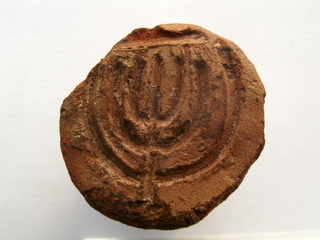
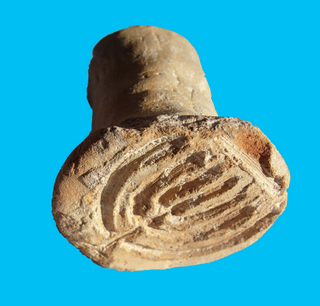
Another sensational archeological find!! The Israel Antiquities Authority announced the finding of a Byzantine era bread stamp showing the menorah [candelabrum] of the Jewish Temple in Jerusalem. The seven-branched menorah was a common Jewish symbol in the centuries after destruction of the Temple by Roman and auxiliary forces in 70 CE. A Greek-language inscription was found on the knob used to hold the stamp. This inscription seems to be the baker's name. He was advertising kosher quality of his product and his own bakery. See photos at bottom of this post.
What do the Arabs and their friends who lately and fashionably have been denying the Jewish history of the Land of Israel [as per PLO charter, Article 20; see at bottom] have to say about that?
- - - - - - - - - - - - - - - - - - - - - - - - - - - - - - - -


A Stamp with the Temple
Menorah was Uncovered in Excavations near Akko (January 2012)


The tiny stamp was used to identify baked products and it probably belonged to a bakery that supplied kosher bread to the Jews of Akko in the Byzantine period

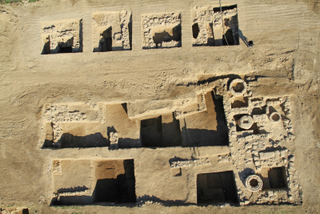
General view of the excavation
A 1,500 year old seal bearing an image of the seven-branched Temple Menorah was discovered near the city of Akko.
A ceramic stamp from the Byzantine period (6th century CE) was discovered in excavations the Israel Antiquities Authority is currently conducting at Horbat Uza east of Akko, prior to the construction of the Akko-Karmiel railroad track by the Israel National Roads Company. This find belongs to a group of stamps referred to as “bread stamps” because they were usually used to stamp baked goods.
According to Gilad Jaffe and Dr. Danny Syon, the directors of the excavation on behalf of the Israel Antiquities Authority, “A number of stamps bearing an image of a menorah are known from different collections. The Temple Menorah, being a Jewish symbol par excellence, indicates the stamps belonged to Jews, unlike Christian bread stamps with the cross pattern which were much more common in the Byzantine period”. According to Syon, “This is the first time such a stamp is discovered in a controlled archaeological excavation, thus making it possible to determine its provenance and date of manufacture. The stamp is important because it proves that a Jewish community existed in the settlement of Uza in the Christian-Byzantine period. The presence of a Jewish settlement so close to Akko – a region that was definitely Christian at this time – constitutes an innovation in archaeological research”. The excavators add, “Due to the geographical proximity of Horbat Uza to Akko, we can speculate that the settlement supplied kosher baked goods to the Jews of Akko in the Byzantine period”.
The stamp is engraved with a seven-branched menorah atop a narrow base, and the top of the branches forms a horizontal line. A number of Greek letters are engraved around a circle and dot on the end of the handle. Dr. Leah Di Segni, of the Hebrew University of Jerusalem suggested this is probably the name Launtius [see comment on name below]. This name was common among Jews of the period and also appears on another Jewish bread stamp of unknown provenance. According to Dr. Syon and Gilad Jaffe, “This is probably the name of the baker from Horbat Uza.”
Horbat Uza is a small rural settlement where clues were previously found that allude to it being a Jewish settlement: a clay coffin, a Shabbat lamp and jars with menorah patterns painted on them were discovered there.
Dr. David Amit of the Israel Antiquities Authority, who has made a study of bread stamps, adds, “A potter engraved the menorah image in the surface of the stamp prior to firing it in a kiln, whereas the owner’s name was engraved in the stamp’s handle after firing. Hence we can assume that a series of stamps bearing the menorah symbol were produced for Jewish bakers, and each of these bakers carved his name on the handle, which also served as a stamp. In this way the dough could be stamped twice before baking: once with the menorah – the general symbol of the Jewish identity of Jewish bakeries, and the private name of the baker in each of these bakeries, which also guaranteed the bakery’s kashrut.


- - - - - - -Article by Israel Antiquities Authority- - - - - -

PLO charter, Article 20, denies the Jewish history of the Land of Israel, the country that the Romans called Judea [IVDAEA] in the heyday of the Roman Empire. The relevant sentence reads:
"Claims of historical or religious ties of Jews with Palestine are incompatible with the facts of history and the true conception of what constitutes statehood." [translation in: Walter Laqueur & Barry Rubin, eds., The Israel-Arab Reader (New York/London: Penguin 2008), p. 119]

Also see this recent post at Emet m'Tsiyon about another recent archeological finding.

Comment on the name on the knob. The announcement above published on the site of the Antiquities Authority may have been translated from Hebrew, which is usually written without vowels, as many readers know. Hence, the name spelled Launtius in the announcement may have been Leontios in Greek.

Labels: , , ,

Thursday, January 05, 2012

New Archeological Discovery in Jerusalem -- Confirms 2nd Temple Practices

One of the many sensational archeological discoveries in Jerusalem in recent years, in and around the Temple Mount, was a seal inscribed with the Aramaic words Daka l'adonay [דכא ליה]. These words mean "Pure for God." The Aramaic daka is equivalent to the Hebrew zakh, meaning pure. The la [ל] means "for." The two letters YH [יה] are an abbreviation for the name of God, usually written YHVH in English by Jews. The ancient Jews did not want to write out the full name of God out of respect for holiness. Here is the story in brief with a nice, big photo:


Ancient Seal with Hebrew Inscription 'Seal of God'

Israeli archaeologists have announced the discovery of a rare clay seal – likely used to certify the purity of ritual objects used in the Second Temple – at an excavation site under the Old City of Jerusalem.The coin-sized seal, measuring about two centimeters in diameter, bears two Aramaic words meaning “pure for God.”

It is the first “direct archaeological evidence of activity on the Temple Mount and the workings of the Temple during the Second Temple period,” according to the Israel Antiquities Authority.
Archaeologist Ronny Reich of Haifa University said the seal dates from between the 1st century B.C. to 70 A.D.

“It seems that the inscribed object was used to mark products or objects that were brought to the Temple, and it was imperative they be ritually pure. This stamped impression is probably the kind referred to in the Mishnah as a chotem, or seal. To the best of our knowledge, this is the first time that such an object or anything similar to it was discovered in an archaeological excavation and it constitutes direct archaeological evidence of the activity on the Temple Mount and the workings of the Temple during the Second Temple period,” archaeologists Eli Shukron of the IAA and Prof. Reich said in a statement.
The rare seal was unearthed at the City of David excavation site just outside the Temple Mount compound. Last month, archaeologists found four bronze coins stamped around 17 A.D. by the Roman official Valerius Gratus during an excavation at the site.

- - - - - - - -
The photo and text below it come from the Land of Israel blog. We know that the seal is from the Second Temple Period since it uses the Hebrew letters in the form that we still use today, with slight differences. In the First Temple Period, Jews/Israelites used an alphabet [כתב עברי קדום] much like that used by the Phoenicians/Canaanites which became the model for the Greek alphabet. The first version of the Greek alphabet was called Phoinikia after the Phoenicians. Alphabet is of course a word derived from the first two letters of the Greek alphabet, alpha and beta, which names are taken from the first two letters of the Hebrew/Canaanite/Phoenician alphabet, alef and beyt.

Labels: ,

Monday, December 28, 2009

Ancient Synagogue from Second Temple Times, One of the Oldest in the World, Found at Migdal [Magdala]

The last year has seen many exciting archaelogical finds throughout Israel, in and around Jerusalem, in the south and the north, the Galilee. Striking findings have been made in the City of David-Pool of Siloam [Silwan] area in Jerusalem which was within the ancient city walls of Jerusalem in the First Temple period but is now outside the Old City, south of the Temple Mount. Here is a discovery of a carved stone from an ancient synagogue from Second Temple Times with a striking photo showing the an ancient menorah, candelabrum. That is, the carving is from the time when the Temple still stood and it depicts the seven-branched menorah used in the Temple. This menorah can be compared with the menorah carved in stone on the Arch of Titus in Rome, which is meant to show the golden menorah from the Jewish Temple in the hands of conquering Roman troops. I would say that the two menorot are fairly similar but not identical. What a difference the artist makes!!

Here is the account of the finding from the website of the Israel Antiquities Authority:

"A synagogue from the Second Temple period (50 BCE-100 CE) was exposed in archaeological excavations the Israel Antiquities Authority is conducting at a site slated for. . . construction. . . on Migdal beach [on Lake Kinneret, the Sea of Galilee]. . . In the middle of the synagogue is a stone that is engraved with a seven-branched menorah (candelabrum), the likes of which have never been seen. The excavations were directed by archaeologists Dina Avshalom-Gorni and Arfan Najar of the Israel Antiquities Authority.

Note the carved stone slab with floral and vegetation designs on top and a menorah accompanied by a pitcher or jar on each side. Carved images of columns appear at the two visible corners.

"The main hall of synagogue is c. 120 square meters in area and its stone benches, which served as seats for the worshippers, were built up against the walls of the hall. Its floor was made of mosaic and its walls were treated with colored plaster (frescos). A square stone, the top and four sides of which are adorned with reliefs, was discovered in the hall. The stone is engraved with a seven-branched menorah set atop a pedestal with a triangular base, which is flanked on either side by an amphora (jars). According to the excavation director, Dina Avshalom-Gorni of the Israel Antiquities Authority, “We are dealing with an exciting and unique find. This is the first time that a menorah decoration has been discovered from the days when the SecondTemple was still standing. This is the first menorah to be discovered in a Jewish context and that dates to the Second Temple period/beginning of the Early Roman period. We can assume that the engraving that appears on the stone, which the Israel Antiquities Authority uncovered, was done by an artist who saw the seven-branched menorah with his own eyes in the Temple in Jerusalem. The synagogue that was uncovered joins just six other synagogues in the world that are known to date to the SecondTemple period”.

"According to the Minister of Culture and Sport, MK Limor Livnat, 'This important find attests to the extensive Jewish settlement in the northern region at the time of the Temple. I am certain that the site will . . . shed light on life in the Jewish settlement [of Migdal] during the Second Temple period'.
. . .

"The synagogue is located in Migdal (‘Magdala’ in Aramaic) [מגדל > מגדלא ], which is mentioned in Jewish sources. Migdal played an important role during the Great Revolt [66-73 CE] and was actually the main base of Yosef Ben Matityahu (Josephus Flavius), commander of the rebellion in the Galilee [at the start before he betrayed]. Migdal also continued to resist the Romans after both the Galilee and Tiberias had surrendered. ‘Magdala’ is mentioned in Christian sources as the place whence Mary Magdalene came [as indicated by her name] . . . After it was conquered by the Romans, the city was destroyed and many of its residents were killed. At the end of the Second Temple period Migdal was an administrative center of the western basin of the Sea of Galilee. Until the founding of Tiberias in the year 19 CE, Migdal was the only important settlement along the shore of the Sea of Galilee." [original article of the Israel Antiquities Authority here . Scroll down]

- - - - - - - - end of text of the Antiquities Authority- - - - - - - - - - - - -

The site is legally the property of a subsidiary of the Franciscan Order who were assigned for centuries by the Vatican to watch over Roman Catholic church interests in the Land of Israel, caring for Catholic pilgrims and Catholic interests in the Christian holy sites as against Greek Orthodox and other Christians. The Order's delegation in the country was called the Custody of the Holy Land, Custodia Terrae Sanctae, in their lingo. The Franciscans intend to build a hotel on the site which may also serve as an ecumenical center for "dialogue" in today's fashionable terminology. This would be a welcome change from the old days when the Franciscans were known for their bigotry and intolerance, especially toward Jews, including in the Land of Israel.

Labels: , , , , ,

Tuesday, August 05, 2008

Inscription Discovered in Jerusalem of Name of Biblical Personage

UPDATING: better photo of stamp seals, 8-8-2008

A new discovery has been made in the area of the original Jerusalem, called `Ir David, City of David, which forms another physical [archeological] confirmation of the real life of a Biblical personage. This discovery is only the latest in a series of discoveries of names of Biblical personages in the `Ir David area. This person's name is found in the Book of Jeremiah [38:1], He lived in the late First Temple period, as did most or all of the other Biblical personages whose names have been found in that area. The building where this bulla [seal stamp impression] was found was also where at least one other bulla was found in `Ir David. The personage was named: Gedalyah son of Pash'hur [Jer 38:1] who served King Zedekiah. The other personage of whom a seal stamp impression was found was: Yehukal son of Shlemyah [Jer 37:3]. His name in Jer 38:1 is spelled Yukal. Here is the Hebrew:
גדליה בן פשחור ויהוכל בן שלמיה שהוא גם יוכל בן שלמיה


The archeologist Dr Eilat Mazar believes that the building where the bullae were found was King David's palace. However, since these names come from the late First Temple period, and King David lived before the Temple was built [It was built by his son, Solomon], then these findings alone are not proof that the building was David's palace, although it was a governmental/administrative structure. Furthermore, it is possible, even likely, that David's original palace was considerably renovated or torn down with a new palace built in its place by later kings. After all, we are talking about a period [of the First Temple] of 400 years approx. Given the proclivity of later rulers to compete with or improve upon or distinguish themselves from earlier ones, especially in regard to building works, then a new royal palace, built with the latest features and luxuries, is quite likely. Consider that in the United States, new presidents who move into the White House almost always do renovation work on the building, some more and some less.

`Ir David, the City of David, was the original Jerusalem where David ruled, built on a narrow ridge that goes downhill from north to south from the Temple Mount. It is now outside the Old City walls although it was within the walls up to and through the first of the two periods of Crusader rule in Jerusalem [up to 1187]. However, the city walls were torn down by one of the Ayyubid rulers [descendants of Saladin] and not rebuilt by later Crusaders, as far as I know. When the Ottoman Empire decided to rebuild the city's walls in the 16th century, the `Ir David area was left outside the walls. The small village of Silwan was built there apparently in the 19th century. Silwan takes its name from the Greek/Latin name Siloam for the pool at the southern, lower end of the ridge, Shilo'ah. Jews lived among Arabs in Silwan village up to the pogroms of the 1930s when Arabs drove Jews out of the neighborhood, although it does not seem that the local villagers took the initiative in the expulsion. Rather the decision seems to have come from the Arab leadership in the Arab Higher Committee, who operated with British encouragement.

See report from `Ir David. For news of the earlier discovery of a similar bulla in that location, see "Good News on the Archeological Front," here. This earlier report is part of another post not directly related to Israeli archeology.

- - - - - - - - - - -
Coming: More on Obama the war candidate -- his mask drops with a loud bang, More on the anti-Jewish racism of the "Peace Process," Jews in Jerusalem, Hebron, the Land of Israel, archeological updates, peace follies, propaganda, etc.

Labels: ,

Friday, February 01, 2008

New Discovery in Old Jerusalem Supports Biblical History

UPDATING 2-6-2008

A new discovery of an ancient stone seal or bulla helps confirm Biblical history for the period of the Return to Zion from Babylonia.

This is a picture with an inscription in the Old Hebrew alphabet [similar to Canaanite]. The three-lettered inscription says: Temekh or, unvoweled: TMKh. The Temekh family is mentioned in a Biblical book as servants in the Temple in the First Temple period [Book of Nehemiah, 7:46, 7:55] --up to the Babylonian Exile when they were exiled to Babylonia-- and as having returned to Zion, that is, to Jerusalem and the Land of Israel [Nehemiah 7:6]. Curiously, the illustration on the bulla shows two priests at an altar with the symbol of the Babylonian god Sin above it [see Jerusalem Post, 1-17-2008]. So we have a bulla found in Jerusalem, in the City of David area, now outside and south of the walls of the Old City, with an inscription in the Old Hebrew alphabet of the name of a family known as Temple servants in a Biblical book, plus a Babylonian symbol. The object was found in an area known to have been the center of worship and administration.

The caption to the photo is somewhat misleading. It says that the seal belonged to "a servant in the First Temple." It would be more correct to say that it belonged to a member of a family that had served the First Temple. The Temekh family likely renewed their service in the Temple [that is, the Second Temple] after the Return to Zion. The Babylonian symbol on the seal indicates that it likely belonged to someone who had come back from Babylonia to Jerusalem. The Temple that was restored after the Return is known as the Second Temple. The presence of a Babylonian symbol may indicate a syncretistic religious attitude on the part of the seal's owner.
- - - - - - - - - - -
UPDATING 2-6-2008
Other experts have studied the inscription on this seal stamp and have reached the conclusion that the inscription should be read Shlomit, also a name known in the Bible from the same time period --the Return to Zion-- as had been previously ascribed to it. This is a woman's personal name, not a family name. The archeologist whose team discovered the seal stamp, Eilat Mazar, has accepted the new reading. Her error was caused by reading the inscription from right to left, which is usual in Hebrew. However, this is a stamp which produces a mirror image impression of itself on the material that it is pressed on, and therefore it should be read left to right. See Solomonia's discussion and links [here]. A woman named Shlomit was the daughter of Zerubabel --a grandson of the last independent king of Judah-- who led Jews coming back from Babylonia to Zion [see I Chronicles 3:19 דברי הימים א]. An archeologist and epigrapher [expert in inscriptions], Ryan Byrne, dates the seal stamp to the First Temple Period:
Byrne suggested that a date in the late seventh or early sixth century was more probable, noting that scene was typical of the Iron Age Levant. . . . [Jerusalem Post, 2-4-2008; updated on JPost website on 2-5-2008].
- - - - - - - - - - - - -end of updating- - - - - - - -

There have been several significant discoveries in that area [City of David] where excavations have been going on for some 18 years, more or less. Several names of persons and families known in Biblical books referring to the late First Temple Period have turned up on these finds, particularly bullae. Here is our earlier report [search for City of David on this post] on one of them. Here is more about discoveries in the City of David [search for City of David on this post].

The City of David area, south of the Temple Mount, was the original Jerusalem built on a narrow ridge with the Qidron Stream or Creek on its eastern side. The ridge comes down from the Temple Mount --originally called Mount Zion, now sometimes called Mount Moriah, and not to be confused with today's Mount Zion which takes its name from the Byzantine church of Nea Sion [= New Zion] now in ruins adjacent to today's Zion Gate. The original Mount Zion became the Temple Mount. The original Jerusalem was the Jebusite city on the ridge described above and now called City of David, since David made his capital there, having transferred it from Hebron, his first capital. The ridge making up the City of David comes down from the Temple Mount to the Pool of Shilo'ah, where the ridge ends.

Bullae, seals, and coins are especially helpful in making connections with ancient events and persons, since these objects are 1) more likely to be well preserved than buildings and other structures; 2) often carry inscriptions mentioning persons and events that may be known from written records that have come down to modern man; 3) often bear symbols and illustrations that also identify them with particular places, cultures, events and persons. The inscriptions on these objects can also supply information about the language, its forms and vocabulary used at the time of their creation.

Here are three books that supply more information --with photographs and drawings-- on seals, bullae, and coins from Israel and nearby areas that sometimes present the names of persons and families known in the Bible.

Nahman Avigad, Hebrew Bullae from the Time of Jeremiah: Remnants of a Burnt Archive (Jerusalem: Israel Exploration Society 1986).

Y [Yaakov] Meshorer, TestiMoney (Jerusalem: Israel Museum 2000). This book covers a longer historical period than Avigad's book, and contains photos and drawings of artifacts of Jewish, Roman, Greek, and Christian provenance.

Ruth Hestrin and Mikhal Dayagi-Mendels, Seals from the First Temple Times: Hebrew, Ammonite, Moabite, Phoenician, and Aramaic (Jerusalem: Israel Museum 1978). This book, full of photos and scientific annotations on actual findings, is available in English and Hebrew editions. I have translated the English title used here from the Hebrew:
רות הסטרין ומיכל דייגי-מנדלס, חותמות מימי בית ראשון: עבריים, עמוניים, מואביים, פיניקיים וארמיים
(Jerusalem: Israel Museum 1978).
I am using the Hebrew edition and am not entirely sure of the English title as published by the Museum.

UPDATING 2-12-2008 --announcement of this discovery from the sponsors, Shalem Center:
"First Temple Seal Discovered in Shalem City of David Excavations
"A black stone seal, bearing the name "Shlomit" has been found in the Area G section of the third phase of the City of David excavations by Shalem Senior Fellow Dr. Eilat Mazar. The unexpected find was reported on the front page of the Jerusalem Post on January 17, and was then thought to bear the name "Temech." Further scholarly review determined that the correct reading is more likely “Shlomit” and may possibly refer to the daughter of Zerubbabel, a grandson of King Jehoachin and leader of the first band of Jews returning from the Babylonian captivity. According to Mazar, the seal which contains Babylonian cultic images was produced in Babylon between 538-445 BCE and belonged to a woman of stature."
Click here for more details from Shalem.
- - - - - -
Coming: Peace follies, the "peace process" and its lies, propaganda, Jews in Jerusalem, Hebron, and the Land of Israel, etc.

Labels: , , , ,

Thursday, November 22, 2007

More on Nadia Abu el-Haj's Frauds

UPDATING ADDITION as of 12-14-2007

Since I last posted on Nadia Abu el-Haj, Columbia University gave her undeserved tenure.

The Current, a publication at Columbia, invited three scholars [Fall 2007 issue] to consider Abu el-Haj's book, which apparently won her tenure. Tenure means that a professor cannot be dismissed. [Here is the link]. These scholars are David Rosen, an anthropologist, James Russell, a specialist in Armenian studies, and Dr Jonathan Rosenbaum, President of Gratz College in Philadelphia. Let's just take a few quotes from Rosen and Russell and comment on them.

David Rosen, Professor of anthropology, Fairleigh Dickinson University:
Facts on the Ground takes issue with the archeological exhibition at Burnt House, a museum located in the Jewish Quarter of Jerusalem's Old City. The official interpretation is that Burnt House is the home of a wealthy Jewish family, possibly of the priestly class, that was destroyed during the Roman siege and conquest of Jerusalem in 70 AD. El-Haj participated in a tour of this Museum and other related sites along with an "American writer" and a "British archeologist," both of whom are unnamed. El-Haj recounts that during the tour, the unnamed and uncited American writer whom she describes as "having authored several books and articles on the politics of archeology in Israel" objected to the established narrative of Burnt House. He argued that the destruction of the house might have resulted from class conflict among Jews in Jerusalem, the result of the simmering anger against Jerusalem's nobility by working class laborers whom Herod the Great had imported to build the temple. He postulated that Burnt House might have been burnt down by an angry Jewish mob long prior to 70 CE. The curator countered that a coin found at the site and dated to approximately 66 CE suggests that the house was burnt close to the 70 CE time period. (The building of Herod's Temple began in about 19 BCE. Herod died in 4 BCE, but the building project may have continued well past his death.) El-Haj counters that this evidence does not preclude the possibility that the site, including the House, may have been burnt down more than once. The unnamed "British archeologist" apparently adds another view by asserting that "most cities burn every twenty to twenty five years."
The point here is that El-Haj suggests there are possible interpretations other than the established narrative. If the Museum were to present either the class struggle narrative or the natural cycle of fire narrative as alternative possibilities, it would, in her view, be a strong corrective to the narrative of national loss and ascendance that she believes wrongfully pervades Israeli archeology. But the text offers no evidence that either of these alternate narratives is probable or even plausible. What weight would any scientific study accord to this exchange other than it demonstrates a passion for contested narratives? It certainly offers nothing probative of the existence of any facts different from those now presented at Burnt House. Certainly it would be interesting and important if El-Haj were actually able to demonstrate that the ethos of Israeli nationalism screened out important and contradictory data. But she offers nothing stronger than anecdote to make the case. Given its methodology, Facts on the Ground accords carefully constructed archeological evidence and off-the-cuff anecdote exactly the same weight.
Here are two bizarre "alternative" narratives about the Burnt House in Jerusalem, on a hill [once called the Upper City] overlooking the Temple Mount, now in the Jewish Quarter. The Upper City was the home of prosperous citizens of Jerusalem. Many residents there were priests [kohanim, כוהנים, "Cohens"] who wanted or needed to live close to the Temple. Let's first look at the bizarre claim that "most [ancient?] cities burn every 20 or 25 years." Ancient cities did burn sometimes as modern cities have. Rome burned under Emperor Nero just a few years before Roman forces --including Arab auxiliaries-- set fire to the Jerusalem Temple. But are there other fires registered in historical records that destroyed all of Jerusalem in the Second Temple period?? On the other hand, the fire that devastated Jerusalem when Vespasian & Titus' forces conquered it from Jewish rebels in 70 CE is registered in a book in Greek by Josephus Flavius [The Jewish War, Book VI: 4:5-5:2], a Jew and protege of Vespasian's family, the Flavians, while the same war is described --from an offensively Roman imperialist viewpoint-- by Tacitus, a Roman historian [The Histories, Book V:1-13]. So this "British archeologist" clown is raising the hypothetical possibility of a hitherto unknown fire at a different time in order to discredit the evidence of written history and of artifacts found in place --such as stone utensils and furnishings-- which point to prosperous inhabitants who carefully observed Jewish dietary laws [I have been in the Burnt House]. Among the artifacts found in the Burnt House was a stone weight inscribed in Aramaic in Hebrew letters: דבר קתרוס , meaning " belonging to Bar Kathros" OR "belonging to the son of Kathros". The Kathros family was a prosperous priestly family mentioned in the Talmud. Further, excavators found Roman coins as well as Jewish coins minted by the rebels for the years 67-69 CE, and none later. Thus, the date of the latest coin found helps set the earliest date for the fire.

The next clown believes the fire resulted from a class uprising by laborers forced by King Herod to work on rebuilding the Temple. Again, is there any written evidence in contemporary historical accounts or in inscriptions that mention or indicate such a mutiny of laborers working on the Temple? Nevertheless, we know something about the Temple builders. Herod recruited kohanim to rebuild an enlarged Temple. In other words, the laborers belonged to the priestly class and most likely would have considered it an honor and a holy duty to rebuild, enlarge and embellish the Holy Temple of Jerusalem. Now, the kohanim --who were a large group in the population-- were divided into shifts or watches [mishmarot, משמרות , sometimes translated as the "courses" of the priesthood]. There were 24 of these watches, based on descent/lineage. Each watch was ordinarily called upon to serve in the Temple in rotation for two weeks at a time. Now, the kohanim as builders were most likely subject to the same periods of service as the kohanim doing purely priestly work at the Temple. In such circumstances, they would not feel like prisoners on a chain gang or shanghaied sailors. They would likely feel pride in doing holy work which was reserved for kohanim alone. Besides, there are other problems with the notion of a laborers' mutiny or riot causing the undeniable fire in the Burnt House. Yet Abu el-Haj in her profound ignorance and malice, in order to further her political purposes, takes the very unlikely hypothesis of a laborers' mutiny seriously. And for this, she gets tenure at a university that ought no longer be considered prestigious.

James Russell, Professor of Armenian Studies, Harvard
The Soviet posture strengthened anti-Semitic and anti-Zionist trends in the Western Left. . .
Edward Said's 1978 book Orientalism. . . proposed a vague socialist agenda, a conspiracy theory, and a new set of victims of imperialism quite unlike the Soviets. These were of course the Arabs—and it was even better that the proximal villain was the ever-sinister, colonizing, comprador Jew. But there is a problem. Said dealt with the 18th and 19th centuries, for the most part, but the Arabs were not the political player in the region then: Ottoman Turkey, a powerful empire and seat of the Muslim Caliphate, ruled them. Millions of Christian Greeks, Romanians, Bulgarians, Serbs, and Armenians labored under Ottoman misrule too. The first four broke away, but the Armenian homeland was in Anatolia itself. So in 1915, during World War I, the Turks decided upon genocide, and carried it out.
Said did not mention the Armenians even once in his book, for it would have made his passive, victimized Islamic world look rather less passive and not at all the victim. It is a glaring omission. Said's book was properly dismissed by many prominent reviewers as amateurish and dishonest—though on other grounds. They did not even notice the Turkish and Armenian aspect. The book might have been consigned to well-deserved oblivion.
I'm not sure that Russell is right about the effect that exposing Said's failure to take the Armenian genocide into account in his propagandistic Orientalism would have had on the book's reputation. Of course, I agree with Russell that Said's omission is a major sign of his dishonesty.

As to Nadia Abu el-Haj, while she denies or minimizes the long-known history of the Jews in the land that the Romans called Judea, she --on the other hand-- espouses the invented notion of a "palestinian people," a big lie created with the purposes of delegitimizing Israel and --in the long term-- of erasing the memory of Jewish history in Israel and anywhere.

UPDATING ADDITION: That the builders assigned by Herod to rebuild the Temple were kohanim [כוהנים ] is attested by Josephus Flavius [יוסף בן מתתיהו ] in The Antiquities of the Jews [XV: 420][Also see Ehud Netzer, "Herod's Building Projects," in Lee I Levine, The Jerusalem Cathedra, vol I (Jerusalem: Yad Izhak Ben Zvi; Detroit: Wayne State University Press 1981)]:
Into none of these courts [of the Temple during reconstruction] did King Herod enter since he was not a priest [kohen, כהן] and was therefore prevented from from doing so. But with the construction of the porticos and the outer courts he did busy himself. . . [Antiquities, XV: 420]
This indicates that the laborers on the Temple rebuilding were not "imported" laborers but kohanim. Before Abu el-Haj undertook to criticize or debunk the generally agreed account of ancient Jerusalem, of Herod's rebuilding and embellishment and enlargement of the Temple, she should have been very familiar with the ancient sources, such as Josephus' account above. That might have saved her from making a fool of herself. On the other hand, maybe the gang of fools, liars, and fanatics that support her don't see her as a fool, since her foolishness or deceit or self-deluded fanaticism --or any combination of these-- fits in well with their own.

Another argument against the two bizarre "alternative" theories is that if the fire had taken place long before the Roman capture in 70 CE, the house would likely have been rebuilt in place as political control and the social order would have remained constant, resuming after the fire. Now, especially if the house had burned down in one of a series of "natural," recurring fires, it is likely that everyone would have had a chance to get away. Yet, the partially calcified skeleton of a young woman was found in the house, indicating that she had not gotten away and the body had not been removed later by survivors, which would likely have occurred in the case of the riot and recurring-fires "alternative" narratives. Nor was the body --in the cellar of a collapsed, burnt house-- removed by Roman soldiers who no doubt removed dead bodies from the city's ruins, but most likely did not bother to exert themselves digging through the ruins looking for bodies that they would not have known were present or not.
Historians hold that the city stayed in its ruined state for 65 years after its destruction in the year 70 CE, with some impoverished Jews living among the ruins. It was rebuilt starting in or shortly after 135 CE by Emperor Hadrian, after he had crushed the Bar Kokhba Revolt. He also renamed the city Aelia Capitolina [Aelius was his clan or gens name] and renamed the Province of Judea [Provincia Iudaea] --Provincia Syria Palaestina. Hadrian's rebuilding was done in a radical, drastic way, although it seems that in various places ruins were not removed but merely built over.

UPDATING OF 12-14-2007 -- additional ancient accounts of the Jewish revolt and its suppression by the Roman Empire
Orosius, VII, 9:5 f.
Sulpicius Severus, II
Dio Cassius [or Cassius Dio], Roman History [Italian edition: Cassio Dione, Storia Romana], LXIII, 22; LXV, 8:1-3, 9:2; LXVI, 1:1-4, 4-7, 9:2, 12:1
Menahem Stern, Greek and Latin Authors on Jews and Judaism, vol. II (Jerusalem: Israel Academy of Sciences 1980), pp 64-67.
- - - - - - - - - -
Coming: the big lies and pretenses of Annapolis, propaganda, peace follies, Jews in Jerusalem, Hebron, and the Land of Israel, etc.

Labels: , , ,

Tuesday, September 18, 2007

Arabs in Gaza Have Destroyed Jewish Antiquities

UPDATED 11-9-2007 & 12-5-2007 [see at bottom]

An Arab propagandist in the guise of an American academic threw all academic objectivity to the winds in a relatively recent book, which she seems to hope will qualify her for tenure at Columbia University. One Nadia Abu al-Haj [also "Nadia el-Haj" & "Nadia Abu el-Haj"] has written Facts on the Ground: Archaeological Practice and Territorial Self-Fashioning in Israeli Society (University of Chicago Press, 2001), which makes a number of outrageous claims. Such as no Jewish past in the land of Israel, such as only a minority of Jews in Jerusalem in Herod's time, etc. One of her claims is that Israeli archeologists systematically disregard artifacts and remains of cultures other than Jewish and that Israeli archeologists may even systematically --or out of habitual negligence-- destroy non-Jewish remains. In fact, the reality is the opposite. One notable case is that of a Jewish inscription in the Hebrew and Greek alphabets that still existed as recently as 20 years ago but has since been destroyed, apparently by Islamic fanatics shortly after the start of the hate movement called the First Intifada [according to Haggai Huberman; the first "intifada" started in December 1987].

This stone carving was found in 1870, apparently by British travelers. It was discovered in the Great Mosque of Gaza on a stone column which was on the upper tier of a double-tiered support for the roof and walls of the mosque. The mosque structure was originally a Crusader church, built after Baldwin I, the Crusader king of Jerusalem, decided to rebuild the city in 1149, after it had lain in ruins since before the Crusader conquest as a result of wars between Seljuk Turks and other Muslim factions, or may have been destroyed at some point by the Crusaders themselves [according to Michael Avi-Yonah]. In this light, it would seem that the Crusaders reused parts --including pillars-- of wrecked earlier buildings that were lying around in the ruined city. The Hebrew and Greek inscriptions together with the decorating medallion/wreath, described by Hershel Shanks as "Hellenistic," indicate that the pillar was part of a synagogue built during the late Roman or the Byzantine periods. The Hebrew and Greek are identical in meaning. They are a man's name, Hananyah son of Jacob,

Hananyah bar Ya`aqob [in Hebrew writing חנניה בר יעקב ]. The Greek inscription is Anania giyo Iako, meaning the same thing. Giyo [in today's Greek yiyo] means son or son of. Other features of the bas-relief include a seven-branched, three-footed menorah, a shofar [used in the synagogues on Rosh haShanah and Yom Kippur], an etrog [citron] and a lulav [palm frond].

Note that the Hebrew inscription uses the Aramaic word bar בר, meaning son or son of, instead of the usual Hebrew word ben בן. Aramaic was the predominant spoken language of the Jews in Israel in the late Roman and Byzantine periods. Hananyah was probably a major donor to building the synagogue, and he was honored with a stone carving in his name, just as Jews today honor major donors with stone or metal plaques in synagogues.

To summarize the history of the inscription of the bas-relief: 1) the synagogue with the carving in Hananyah's name was erected in the late Roman or Byzantine periods; 2) the synagogue may have been destroyed at the time of the Arab conquest or in one of the inter-Muslim wars in the early Muslim period before the Crusades, or when the Crusaders destroyed the city of Gaza --according to Michael Avi-Yonah [in the Encyclopedia Judaica, vol 7]--; 3) in 1149, Baldwin I decreed that Gaza be rebuilt; the column from the ruined synagogue was reused to build a Crusader cathedral; 4) after the Muslim reconquest of Gaza, the cathedral was made into a mosque, called the Great Mosque of Gaza; 5) 1870 the bas-relief with its Hebrew and Greek inscriptions was rediscovered on an upper tier of columns supporting the mosque structure; 6) shortly after the start of the hate movement called the First Intifada [December 1987], the bas-relief was destroyed by Muslim haters, apparently because this remnant of ancient Jewish civilization in the Land of Israel was intolerable to them both as Muslims and Arab nationalists. In order to destroy it they needed long ladders, or maybe a scaffolding, in order to get up to the height of the stone carving on the pillar.

Sources:

Michael Avi-Yonah, "Gaza," Encyclopedia Judaica, vol 7.
Haggai Huberman, יהודים בעזה (Netsarim: the Center for the Heritage of the Jews of Gaza 1993)
Hershel Shanks, Judaism in Stone: The Archaeology of Ancient Synagogues (New York: Harper & Row; Washington, DC: Biblical Archaeology Society, 1979).

Nadia Abu al-Haj's denial of the Jewish past in the Land of Israel seems to work by the rule of Article 20 of the PLO Charter:
Claims of historical or religious ties of Jews with Palestine are incompatible with the facts of history. . . [from Article 20 of the PLO Charter; Harkabi trans]
Since the PLO Charter denies any Jewish history in the Land of Israel, then those who support the aims of that Charter and those who devoutly believe in it, are likely to deny [or, if under pressure to admit some Jewish link to Israel, then minimize] Jewish history in Israel, which is what Abu al-Haj does, no matter what the actual facts are as attested by archeological findings, by ancient writings, whether pagan writings in Greek or Latin, whether Jewish writings in Hebrew, Aramaic, or Greek, or even as attested in the Quran and Arab historiography [see our earlier post on the Quran's Zionist passages, as well as Arab historians writing before invention of the "palestinian people" notion]. Since Abu al-Haj is interested in building up a mystique of the newly invented and supposedly put-upon "palestinian people," it is unlikely that her book reports that the centuries-old Jewish community of Gaza was brought to a violent end in 1929, as the Gaza Jews were driven out by Arab pogroms.

It is noteworthy that Abu al-Haj's tract was published by the University of Chicago Press, proving once again that academic standards among the academic publishers are down.

UPDATING: The Biblical Archeology Review published an article about the destruction of this bas relief stone carving in its issue of January/February 2001. It also reports Arab destruction of other Jewish archeological remains in Gaza and elsewhere [including the Sinai under Egyptian control]. Most notably, perhaps, it shows an Arab mob happily wrecking the Tomb of Joseph in Sh'khem and desecrating Jewish holy writings. For more on Joseph's Tomb see here.
Also see on Joseph's Tomb & its wrecking by an Arab mob:
Sharon Waxman, "They Knew Not Joseph," Jerusalem Post, 24 November 2000.

- - - - - -
Here is a relevant page from the blog of Paula Stern who awakened us to Columbia's support for historical falsification to Israel's detriment.
- - - - - - - - - - - - - - - -
Coming: A leading British jounalist gushes over walt-mearsheimer, Jews in the Land of Israel, Jerusalem, Hebron, peace follies, propaganda, etc.

Labels: ,